
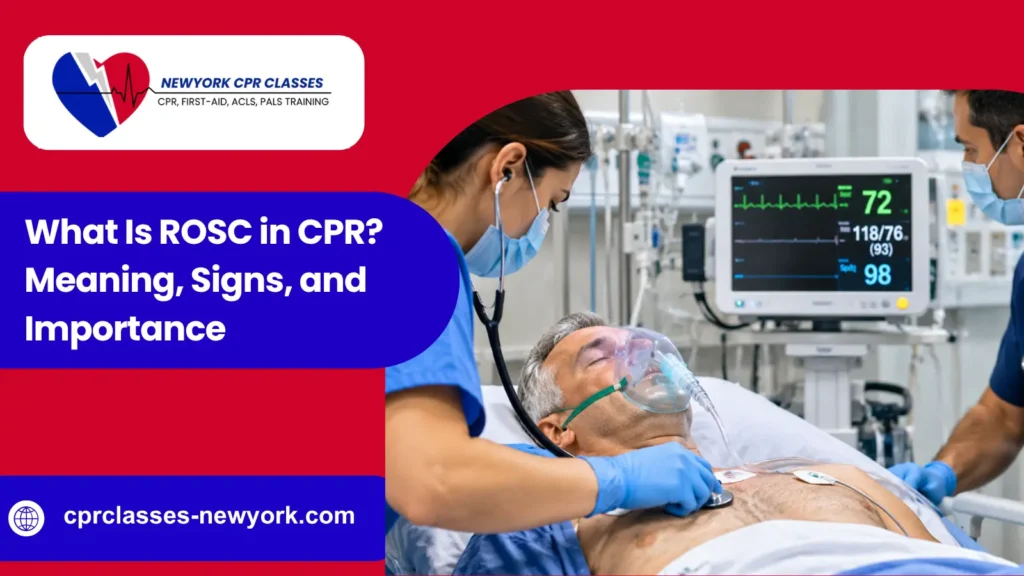
ROSC (Return of Spontaneous Circulation) in CPR refers to the return of an effective heartbeat and blood circulation after cardiac arrest. It occurs when the heart resumes pumping blood throughout the body without the need for chest compressions.
However, the return of circulation does not necessarily mean the patient is conscious or has fully recovered. Further medical treatment is required to stabilize heart function, maintain oxygen delivery, and prevent complications following cardiac arrest. This guide explains what happens during ROSC, its key signs, how it is achieved during CPR, and its importance in post-cardiac arrest care.
What Happens During ROSC?
During ROSC (Return of Spontaneous Circulation), the heart regains the ability to pump blood effectively without assistance from chest compressions. This restores blood flow to the brain, heart, and other vital organs, allowing oxygen and nutrients to reach the body’s tissues again.
As circulation returns, the body transitions from cardiac arrest to a state in which the heart can pump blood effectively again. However, the heart and other organs may still be affected by the lack of oxygen and reduced blood flow during the arrest. Some patients may require oxygen therapy, mechanical ventilation, medications to support blood pressure, and continued monitoring.
ROSC marks an important stage in resuscitation, but it does not necessarily mean the patient has fully recovered. Further post-cardiac arrest care is needed to stabilize circulation, assess organ function, and address the underlying cause of cardiac arrest.
What Are the Signs of ROSC?
The main signs of Return of Spontaneous Circulation (ROSC) include a palpable pulse, measurable blood pressure, a sudden rise in end-tidal carbon dioxide (EtCO₂), spontaneous breathing, purposeful movement, and signs of consciousness. These indicators suggest that the heart has regained the ability to pump blood after cardiac arrest. Healthcare professionals assess these clinical changes during and after CPR to determine whether spontaneous circulation has returned.
1. Return of a Palpable Pulse
A palpable pulse is one of the most important signs that spontaneous circulation may have returned. Healthcare professionals check for a pulse, commonly at the carotid or femoral artery, to determine whether the heart is pumping blood through the body. A definite pulse indicates that the heart has resumed pumping blood without the need for chest compressions.
2. Measurable Blood Pressure
The return of measurable blood pressure indicates that the heart is generating pressure to move blood through the arteries. During cardiac arrest, blood pressure is absent or cannot be reliably measured. After ROSC, a blood pressure reading may become detectable, helping medical professionals assess whether circulation has been restored and whether the patient needs treatment to maintain adequate blood flow.
3. Sudden Increase in End-Tidal Carbon Dioxide (EtCO₂)
A sudden and sustained increase in end-tidal carbon dioxide (EtCO₂) can be an early indicator of ROSC during CPR. EtCO₂ measures the amount of carbon dioxide released at the end of exhalation. When the heart resumes effective pumping, it carries more carbon dioxide from the body’s tissues to the lungs, increasing the amount of carbon dioxide measured at the end of exhalation (EtCO₂). However, this change alone does not confirm ROSC. Healthcare professionals must assess the patient for a pulse and other evidence of circulation.
4. Spontaneous Breathing
After ROSC, a patient may begin breathing independently as blood flow and oxygen supply to the brain improve. However, gasping or irregular breathing can also occur during cardiac arrest, so breathing alone does not confirm ROSC.
5. Movement or Coughing
Some patients may begin moving their limbs, coughing, swallowing, or showing purposeful physical responses when circulation returns. These movements can occur during resuscitation or shortly after ROSC. The patient may also resist procedures such as airway suctioning or the insertion of an airway device. Such responses can suggest the return of neurological activity, although they do not independently confirm that spontaneous circulation has been restored.
6. Signs of Consciousness
A patient may show signs of regaining consciousness after ROSC, such as opening their eyes, responding to verbal instructions, or reacting to people around them. The level of awareness can vary. Some patients may respond purposefully, while others remain unconscious despite the return of circulation. Therefore, a lack of consciousness does not mean ROSC has not occurred.
Important: A palpable pulse is a key sign of ROSC. Changes in EtCO₂, breathing, movement, or consciousness may also suggest that circulation has returned. However, healthcare professionals must check for a pulse and assess other signs of circulation to confirm ROSC.
How Is ROSC Achieved During CPR?
ROSC is achieved during CPR by restoring the heart’s ability to pump blood effectively through a combination of high-quality chest compressions, early defibrillation when indicated, appropriate medications, and treatment of the underlying cause of cardiac arrest. These resuscitation measures help maintain blood flow to vital organs and support the return of spontaneous circulation. The specific interventions depend on the patient’s heart rhythm and response to treatment.
1. High-Quality CPR
High-quality CPR supports blood circulation while emergency responders work to restore the heart’s function. Effective chest compressions help maintain blood flow to the heart and brain, improving the conditions needed for successful resuscitation.
For adult CPR, the American Heart Association recommends:
- Compression rate of 100 to 120 compressions per minute.
- Compression depth of at least 2 inches (5 cm), while avoiding depths greater than 2.4 inches (6 cm).
- Allowing complete chest recoil after each compression.
- Minimizing interruptions in chest compressions.
- Providing appropriate ventilation without excessive ventilation.
Maintaining high-quality chest compressions throughout resuscitation helps support blood circulation and improve the chances of achieving ROSC.
2. Early Defibrillation
Defibrillation is an important intervention for cardiac arrest caused by shockable heart rhythms, particularly ventricular fibrillation (VF) and pulseless ventricular tachycardia (pVT).
An AED or manual defibrillator delivers an electrical shock to help terminate the abnormal electrical activity. This gives the heart an opportunity to regain an organized rhythm.
Defibrillation does not guarantee ROSC. Resume CPR immediately after the shock and continue until signs of ROSC appear or the AED instructs otherwise.
Asystole and pulseless electrical activity (PEA) are nonshockable rhythms. Defibrillation is not indicated for these rhythms.
3. Advanced Cardiac Life Support (ACLS)
Advanced Cardiac Life Support (ACLS) involves additional interventions performed by trained healthcare professionals during cardiac arrest.
Depending on the patient’s condition, these interventions include:
- Epinephrine: Administered during cardiac arrest according to the appropriate resuscitation algorithm to improve coronary and cerebral perfusion.
- Antiarrhythmic medications: Amiodarone or lidocaine may be administered for ventricular fibrillation or pulseless ventricular tachycardia that does not respond to defibrillation.
- Advanced airway management: An advanced airway may be used to support ventilation and oxygen delivery during resuscitation.
- Intravenous or intraosseous access: Provides a route for administering medications and fluids when indicated.
These interventions support resuscitation but must be performed alongside high-quality CPR and appropriate rhythm management.
4. Identifying and Treating Reversible Causes
Cardiac arrest can result from different medical conditions. Identifying the underlying cause is essential because restoring a heartbeat without treating the problem may not prevent another cardiac arrest.
Healthcare professionals use the H’s and T’s to remember important reversible causes:
| H’s | T’s |
| Hypovolemia | Tension pneumothorax |
| Hypoxia | Cardiac tamponade |
| Hydrogen ion (acidosis) | Toxins |
| Hypokalemia or hyperkalemia | Thrombosis (pulmonary) |
| Hypothermia | Thrombosis (coronary) |
For example, severe blood loss can reduce the amount of blood available for circulation, while hypoxia deprives the heart and other organs of oxygen. Treating these underlying conditions is an important part of cardiac arrest management.
What Happens Immediately After ROSC?
The return of spontaneous circulation marks the beginning of post-cardiac arrest care. Although the heart has regained effective circulation, the patient may still have unstable heart function, breathing difficulties, or complications caused by reduced blood flow during cardiac arrest.
The 2025 American Heart Association guidelines recommend immediate stabilization and continued evaluation after ROSC.
1. Airway Management
Healthcare professionals assess whether the patient can maintain an open airway and protect it independently. An advanced airway device may be inserted or adjusted as needed to keep the patient’s breathing passage open and allow effective ventilation.
2. Oxygenation and Ventilation
The medical team monitors oxygen levels and carbon dioxide to ensure adequate gas exchange.
The 2025 AHA guidelines recommend initially using 100% inspired oxygen until oxygen saturation or arterial oxygen levels can be measured reliably. Once reliable readings are available, adjust the oxygen supply to maintain the patient’s oxygen saturation between 90% and 98%.
For adults who remain comatose after ROSC, maintaining carbon dioxide levels within a normal physiological range is also important.
3. Blood Pressure and Circulation Management
The heart may remain weakened after cardiac arrest, making blood pressure monitoring essential.
Healthcare professionals monitor circulation and treat low blood pressure when necessary. The 2025 AHA guidelines recommend maintaining a mean arterial pressure (MAP) of at least 65 mm Hg in adults after ROSC.
4. Identifying the Cause of Cardiac Arrest
Medical teams investigate why cardiac arrest occurred and whether the patient has developed complications during resuscitation.
Diagnostic tests may include:
- A 12-lead electrocardiogram (ECG) to evaluate heart rhythm and identify possible cardiac abnormalities.
- Blood tests to assess electrolyte levels, blood glucose, and other important indicators.
- Echocardiography to evaluate the heart’s pumping function.
- CT imaging when necessary to investigate the cause of cardiac arrest or complications associated with resuscitation.
5. Neurological Assessment and Temperature Control
The brain may be affected by reduced oxygen delivery during cardiac arrest. Healthcare professionals assess the patient’s neurological condition and monitor for seizures or other complications.
For adults who remain unresponsive to verbal commands after ROSC, the 2025 AHA guidelines recommend a deliberate temperature control strategy maintained for at least 36 hours.
6. Continued Intensive Care
Some patients require admission to an intensive care unit (ICU) for ongoing monitoring and treatment.
Care may include cardiovascular support, respiratory support, treatment of the underlying cause, neurological monitoring, and rehabilitation planning.
The goal is to maintain stable organ function and support the patient’s recovery after cardiac arrest.
What Is the Difference Between ROSC and Sustained ROSC?
The main difference between ROSC and sustained ROSC is that ROSC refers to the return of spontaneous circulation after cardiac arrest, while sustained ROSC means that circulation continues for at least 20 consecutive minutes without chest compressions.
| Feature | ROSC | Sustained ROSC |
| Definition | The heart regains the ability to pump blood effectively without chest compressions. | The restored circulation continues for at least 20 consecutive minutes without chest compressions. |
| Duration | Can last for a few seconds, minutes, or longer. | Lasts for at least 20 consecutive minutes. |
| Stability | Circulation may return briefly before another cardiac arrest occurs. | Circulation has continued for the required period, although the patient may still be medically unstable. |
| Clinical Significance | Indicates that resuscitation has restored spontaneous circulation. | Serves as an important measure of successful resuscitation in clinical research and reporting. |
The minimum period used to define sustained ROSC can vary between clinical studies and reporting systems. Therefore, the definition used must be considered when comparing resuscitation outcomes.
Why Is ROSC Important in CPR?
ROSC is a critical milestone in CPR because it marks the transition from active resuscitation to post-cardiac arrest treatment. Once spontaneous circulation returns, healthcare professionals can focus on stabilizing the patient’s condition, identifying the cause of cardiac arrest, and preventing another arrest.
Restored circulation helps deliver oxygen to vital organs, limiting further damage and supporting the patient’s chances of survival. However, continued medical monitoring and treatment remain essential, as patients may experience complications even after ROSC.
Does ROSC Mean the Patient Has Survived Cardiac Arrest?
No. ROSC and survival after cardiac arrest are different outcomes.
ROSC confirms that effective spontaneous circulation has returned. Survival refers to the patient remaining alive after the cardiac arrest, such as surviving hospital admission or being discharged from the hospital.
Even after achieving ROSC, a patient may experience complications such as brain injury, heart dysfunction, respiratory problems, or recurrent cardiac arrest.
The chances of recovery depend on factors such as:
- The underlying cause of cardiac arrest.
- How quickly CPR was started.
- The quality of CPR and whether defibrillation was delivered when indicated.
- How long the cardiac arrest lasted before circulation returned.
- The extent of damage to the brain and other organs.
- The patient’s response to post-cardiac arrest treatment.
Some patients regain consciousness and recover, while others require prolonged intensive care or experience lasting complications.
Final Thoughts
ROSC (Return of Spontaneous Circulation) marks the restoration of effective blood circulation after cardiac arrest and is an important goal of CPR and advanced resuscitation. Recognizing its signs, understanding how it occurs, and providing appropriate post-cardiac arrest care are essential for improving patient outcomes.
At New York CPR Classes, you can develop the knowledge and practical skills needed to respond to cardiac emergencies through AHA BLS, ACLS, and PALS training. Our courses help healthcare professionals strengthen their resuscitation skills and prepare for emergencies where effective CPR and timely intervention can make a difference.
Frequently Asked Questions About ROSC
What Does ROSC Stand for in Medical Terms?
ROSC stands for Return of Spontaneous Circulation. It describes the restoration of effective cardiac activity and blood circulation after cardiac arrest without continued chest compressions.
What Is the Percentage of ROSC?
The percentage of ROSC varies depending on where cardiac arrest occurs and the patient’s circumstances. According to the 2024 CARES national report, 25.3% of out-of-hospital cardiac arrest patients achieved sustained ROSC in the field. In-hospital ROSC rates can be higher, with one national registry study reporting approximately 72%.
Can ROSC Occur Without Defibrillation?
Yes. ROSC can occur without defibrillation, particularly in patients with nonshockable rhythms such as asystole and pulseless electrical activity. High-quality CPR, appropriate medications, and treatment of reversible causes are important components of resuscitation.
Can a Patient Be Unconscious After ROSC?
Yes. A patient can regain spontaneous circulation but remain unconscious. This can happen when the brain has not received enough oxygen during cardiac arrest.
Do You Stop CPR if ROSC Occurs?
Yes. Stop CPR once ROSC is confirmed because the heart has regained effective circulation. Healthcare professionals then assess the patient’s condition and begin post-cardiac arrest care. If the patient experiences another cardiac arrest, CPR must be restarted immediately.
Do You Always Intubate After ROSC?
No. Intubation is not necessary for every patient after ROSC. It depends on the patient’s ability to maintain an open airway, breathe adequately, and protect their airway. Patients who cannot maintain adequate breathing or protect their airway may require endotracheal intubation and mechanical ventilation.
Can You Get ROSC From Just CPR?
Yes. In some cases, CPR alone can restore spontaneous circulation without defibrillation or advanced medications. However, the chances depend on the cause of cardiac arrest and the patient’s heart rhythm. CPR helps maintain blood flow to vital organs while emergency responders provide further treatment when needed.
What Three Tests Should Be Considered Soon After ROSC Is Achieved?
Three important diagnostic tests considered after ROSC are:
- 12 Lead ECG: Identifies abnormal heart rhythms and signs of a heart attack that may have caused cardiac arrest.
- Echocardiogram: Uses ultrasound to evaluate heart function and identify structural or functional problems.
- Computed Tomography (CT) Scan: Helps identify possible causes of cardiac arrest, such as bleeding in the brain, pulmonary embolism, or complications from resuscitation.