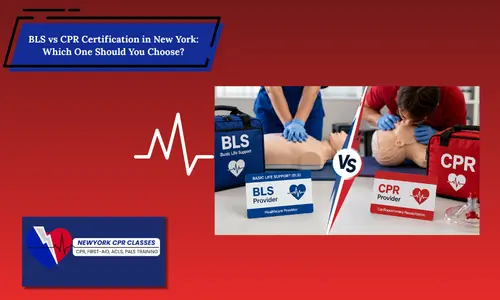
BLS and CPR certifications both prepare people to respond to life-threatening situations, but they serve different purposes. CPR training focuses on essential lifesaving skills such as chest compressions, rescue breathing, and AED use. At the same time, BLS includes these skills as part of a broader approach to professional resuscitation and team response.
The difference becomes important when certification is required for a job, school program, or professional role in New York. A parent, teacher, childcare provider, or workplace employee may only need CPR and AED certification, while a nurse, physician, EMT, or other healthcare professional may need BLS certification.
Choosing between BLS and CPR depends on what your job, school, or organization requires. This guide explains the key differences between CPR and BLS certification in New York, including what each course covers, who needs it, and how to choose the right certification for your requirements.
What Is CPR Certification?
Cardiopulmonary Resuscitation (CPR) certification is a professional credential that confirms an individual has completed approved training and demonstrated the skills needed to respond to cardiac and breathing emergencies. The American Heart Association (AHA) provides widely recognized CPR guidelines and training courses based on current resuscitation science.
Hearsaver CPR certification commonly covers several practical skills that help participants respond effectively in an emergency:
- Emergency Recognition: Identifying when a person needs immediate CPR and emergency medical assistance.
- Chest Compressions: Learning proper hand placement, compression depth, rate, and technique.
- Rescue Breathing: Providing rescue breaths when they are needed during CPR.
- AED Use: Safely operating an automated external defibrillator during a cardiac arrest emergency.
- Choking Response: Responding appropriately when a person is experiencing a blocked airway.
- Emergency Response: Understanding how to activate emergency medical services and continue care until help arrives.
What Is BLS Certification?
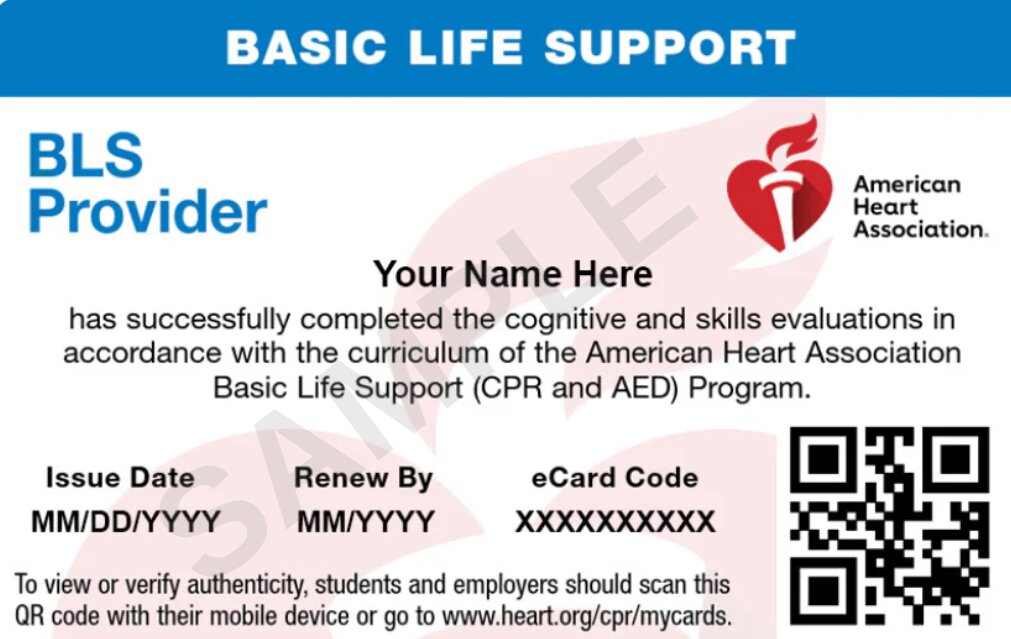
A Basic Life Support (BLS) certification is a professional credential that prepares healthcare providers and first responders to recognize and respond to life-threatening emergencies such as cardiac arrest and respiratory distress. The American Heart Association (AHA) develops evidence-based BLS guidelines and training courses that support effective emergency response and resuscitation.
AHA BLS certification in New York commonly covers:
- Cardiac Arrest Recognition: Recognizing when a patient is experiencing cardiac arrest and taking the appropriate action.
- High-Quality CPR: Applying proper compression technique and maintaining effective CPR throughout resuscitation.
- AED Operation: Using an automated external defibrillator safely and following its prompts during resuscitation.
- Bag Mask Ventilation: Providing ventilations with a bag mask device when indicated.
- Team Dynamics: Communicating clearly and coordinating responsibilities with other members of a resuscitation team.
- Choking Response: Responding appropriately to severe airway obstruction in adults, children, and infants.
- Age-Specific Skills: Applying appropriate techniques based on whether the patient is an adult, child, or infant.
BLS vs CPR: What Is the Difference?
The main distinction between CPR and BLS is the level of training and the setting in which the skills are applied. CPR focuses on the essential actions needed to respond to cardiac arrest, while BLS covers these skills within a broader approach to professional resuscitation and team response.
The comparison below highlights the practical differences between the two certifications, including who typically takes each course, the skills involved, and the type of emergency response covered.
| Feature | CPR Certification | BLS Certification |
| Full Form | Cardiopulmonary Resuscitation | Basic Life Support |
| Training Level | Focuses on essential lifesaving response | Provides broader training for professional resuscitation |
| Resuscitation Approach | Primarily focuses on responding as an individual rescuer | Includes coordinated response when multiple trained rescuers are involved |
| Equipment | AED and basic CPR equipment | AED, bag-mask device, and other equipment used during professional resuscitation |
| Airway Support | Covers basic airway and breathing support appropriate to the course | Includes more comprehensive ventilation and airway management skills |
| Patient Groups | Course content may cover adults, children, or infants depending on the certification | Training commonly addresses adult, child, and infant patients |
| Common Settings | Homes, schools, workplaces, childcare facilities, fitness centers, and community environments | Hospitals, clinics, emergency medical services, dental offices, and other healthcare environments |
Who Should Get CPR Certification?
CPR certification can be a practical option for people in New York who need to learn how to respond to an emergency but do not work in a clinical healthcare role. Many workplaces and organizations in New York have specific certification requirements, so confirm which certification you need before registering.
A Heartsaver CPR course may be suitable for:
- Teachers and school employees
- Childcare providers and caregivers
- Coaches and fitness professionals
- Workplace employees
- Parents and family members
- Community members
- Students whose program specifically requires CPR certification
The exact course you need depends on your responsibilities and your role’s requirements. Some positions may require CPR and AED training, while others may require a broader First Aid and CPR certification.
Who Should Get BLS Certification?
BLS certification is generally the better choice for healthcare professionals in New York who are expected to respond to cardiopulmonary emergencies as part of their professional responsibilities. BLS training emphasizes effective resuscitation and coordinated response with other team members during an emergency.
The AHA BLS certification is commonly required or requested for:
- Nurses
- Physicians
- EMTs and Paramedics
- Dentists and Dental Professionals
- Medical Assistants
- Healthcare Students
- Respiratory Therapists
- Pharmacists
- Physical and Occupational Therapists
- Radiologic Technologists
- Healthcare Support Staff
- Lifeguards and Aquatic Safety Professionals
- Other Professionals Providing Direct Patient Care
Does BLS Include CPR?
Yes. CPR is a fundamental part of BLS training. Participants learn how to recognize cardiac arrest and provide high-quality CPR while also learning additional skills relevant to professional resuscitation.
BLS training also emphasizes coordinated team response, effective ventilation, AED use, and adapting care based on the situation. The broader scope makes BLS appropriate for healthcare professionals who may need to respond to emergencies alongside other members of a resuscitation team.
Is BLS Harder Than CPR?
BLS can feel more comprehensive than a general CPR course, particularly for someone who has never received healthcare-focused training. The course covers CPR skills while also introducing additional concepts related to professional resuscitation and team response.
The difficulty depends on how comfortable you are with the skills covered in the course. Hands-on practice can help participants become more comfortable with chest compressions, ventilations, AED operation, and other practical skills before completing their certification requirements.
Can You Use BLS Certification Instead of CPR Certification?
Yes, BLS certification can be used instead of standard CPR certification in many situations. The BLS course includes the essential CPR skills covered in a standard certification, along with additional training for responding to life-threatening emergencies.
However, acceptance depends on the requirements of the employer, school, licensing program, or organization. Checking the stated certification requirements before enrolling can help you choose the credential that meets their expectations.
Which Certification Should You Choose?
Start by looking at what your workplace, school, or professional organization requires. If you work in a clinical role or are preparing for one, take an AHA BLS class. If you need basic emergency response skills for a workplace, childcare role, school, or personal knowledge, a CPR course may be sufficient.
Consider these questions before registering:
- Does your employer specifically require BLS?
- Are you working in a healthcare profession?
- Does your school or training program specify an AHA BLS course?
- Do you only need CPR and AED training?
- Does your organization require First Aid along with CPR?
- Which certification does your employer accept?
Taking a few minutes to confirm the requirement can help you avoid completing a course that does not meet your organization’s standards.
Final Thoughts
CPR and BLS both provide valuable lifesaving skills, but they are not interchangeable in every situation. CPR focuses on essential emergency response skills, while BLS covers these skills within a broader approach to resuscitation for healthcare professionals and trained responders.
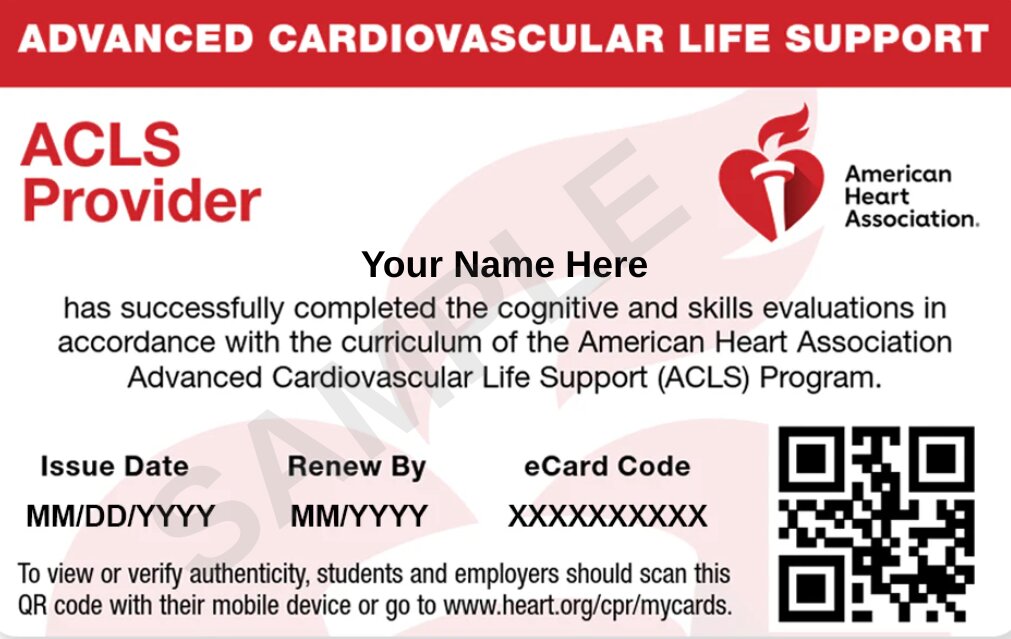
New York CPR Classes offers AHA BLS, ACLS, PALS, and Heartsaver CPR courses with flexible training options. You can complete the online coursework at your convenience and then visit one of our skills verification stations in New York to complete the hands-on portion. After successfully completing the required skills session, you can receive your official AHA eCard the same day.
If you are still unsure which course to choose, contact us, and our team can help you select the right option.
Frequently Asked Questions
Can I take an AHA CPR or BLS course online in New York?
Yes, blended learning options are available for AHA CPR and BLS certification courses. Participants can complete the online coursework before visiting a skills verification station for the required hands-on portion.
How much do CPR and BLS certification courses cost in New York?
Your certification cost in New York depends on the course you choose and the training format you select. Generally, the BLS course for initial or renewal certification costs $90 to $120, while the Heartsaver CPR course costs $95 to $135.
What should I bring to a CPR or BLS skills verification session?
Participants should bring any required information or documentation specified by their training provider. If you have completed online coursework, keep the required completion information available for your skills session.
Can I get my AHA eCard immediately after completing the course?
Yes, participants receive their official AHA eCard on the same day after successfully completing all required course components.
Is an AHA CPR or BLS certification accepted outside New York?
AHA certifications are widely recognized across the United States. However, employers, schools, and licensing organizations can have specific credential requirements, so confirm acceptance with the organization requesting your certification.
Can someone with no healthcare experience enroll in a BLS course?
Yes, you can enroll in a BLS course even if you have no prior healthcare experience. BLS courses are primarily intended for healthcare professionals, first responders, and healthcare students, but they are also open to individuals who need this certification for their role.
How often do CPR and BLS certifications need to be renewed?
AHA CPR and BLS certifications are generally valid for two years. Renew your certification before it expires to keep your credential valid.
What if I do not pass the skills session on my first attempt?
If you do not complete the skills session on your first attempt, you can review the areas that need improvement and try again. During the session, the voice-assisted manikin provides real-time feedback to help you identify and correct mistakes. You can continue practicing until you demonstrate the required skills and complete the verification process.