
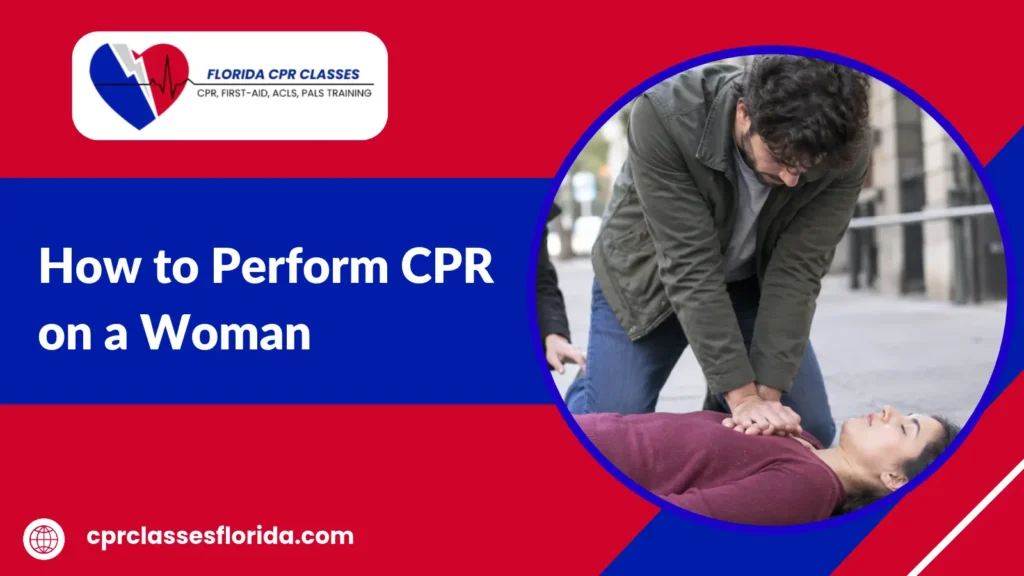
Performing CPR on a woman follows the same basic principles as performing CPR on a man. However, concerns about breast placement, clothing, bra removal, and physical contact can make some people hesitate when responding to a woman experiencing cardiac arrest.
These concerns should never delay emergency care. Proper CPR focuses on the center of the chest, and the presence of breasts does not change the recommended compression technique.
This guide explains how to perform CPR on a woman, where to place your hands, and what to consider when providing CPR to women with large breasts or during pregnancy.
Is CPR Different for Women and Men?
No. CPR is performed using the same basic technique for adult women and men. Breast size, breast shape, and biological sex do not change the recommended approach to resuscitation.
However, there are some practical considerations when performing CPR on women. Rescuers may have difficulty identifying the correct hand placement because of breast tissue or may hesitate due to concerns about physical contact and privacy.
The main differences to consider are:
- Breast anatomy: Rescuers must identify the breastbone rather than use breast position as a reference for hand placement.
- Clothing and bras: Clothing does not need to be removed for chest compressions, but the chest must be exposed for direct AED pad placement on bare skin.
- Privacy concerns: Some rescuers hesitate to expose a woman’s chest when using an AED. These concerns should not delay emergency treatment.
- Pregnancy: Pregnant women may require additional resuscitation considerations, particularly when the uterus is large enough to affect blood circulation.
Although these situations require some additional awareness, they do not change the fundamental CPR technique used for adult women.
When Should You Perform CPR on a Woman?
Perform CPR when a woman is unresponsive and is not breathing normally or is only gasping for air.
These are the main warning signs of cardiac arrest:
- Unresponsiveness: She does not respond when you tap her shoulders and shout.
- Absent normal breathing: Her chest does not rise and fall normally.
- Agonal breathing: She makes occasional gasping, snorting, or irregular breathing sounds instead of breathing normally.
Do not mistake occasional gasps for normal breathing. Agonal breathing can occur during cardiac arrest and is not a reason to delay CPR.
If a woman is unconscious but breathing normally, CPR is not indicated. Call emergency services, monitor her breathing, and follow the emergency operator’s instructions.
8 Steps to Perform CPR on a Woman
Follow these eight steps when performing conventional CPR on an adult woman experiencing cardiac arrest.
Step 1: Check the Surroundings for Safety
Before approaching the woman, check whether the surrounding area is safe. Look for potential hazards such as moving vehicles, exposed electrical wires, fire, or other dangers that could put you at risk.
If the area is safe, approach the woman and prepare to assess her condition. Do not attempt to move her unless there is an immediate danger at the scene.
Step 2: Check Responsiveness and Breathing
Tap her shoulders and call out loudly to check if she responds. Check for normal breathing by watching her chest for movement.
Spend no more than 10 seconds assessing her breathing. If she does not respond and is not breathing normally or is only gasping, assume she is experiencing cardiac arrest.
Remember that occasional gasps, snorting, or irregular breathing are not normal breathing. Do not delay CPR while waiting for these signs to disappear.
Step 3: Call Emergency Services
Call 911 or your local emergency number immediately. Explain that you have found an unresponsive woman who is not breathing normally.
If someone else is nearby, ask them to call emergency services while you prepare to perform CPR. If you are alone, use your phone’s speaker function so you can communicate with the emergency operator while keeping your hands free.
Follow the operator’s instructions throughout the emergency.
Step 4: Get an Automated External Defibrillator (AED)
Ask someone nearby to locate the nearest automated external defibrillator (AED) and bring it to the scene.
An AED analyzes the heart’s electrical rhythm and determines whether an electric shock is needed to help restore a normal rhythm.
If an AED is available nearby, use it as soon as possible. Do not delay chest compressions while waiting for someone to retrieve the device.
Step 5: Position Your Hands Correctly
Lay the woman flat on her back on a firm, level surface. Kneel beside her chest and locate the center of the breastbone (sternum).
Place the heel of one hand on the lower half of the sternum. Put your other hand directly on top and interlock your fingers, keeping them raised away from the ribs.
Position your shoulders directly above your hands and keep your elbows straight.
For women with larger breasts, move breast tissue aside only when necessary to locate the breastbone. Your hands must rest on the sternum, not on the breasts.
Step 6: Perform Chest Compressions
Once your hands are positioned correctly, begin chest compressions.
Follow the recommended adult CPR guidelines:
- Compression rate: Perform 100 to 120 compressions per minute.
- Compression depth: Compress the chest at least 2 inches (5 cm) but no deeper than 2.4 inches (6 cm).
- Chest recoil: Allow the chest to return to its normal position after each compression.
- Hand position: Keep both hands on the lower half of the sternum.
- Body position: Keep your arms straight and shoulders directly above your hands.
Push down firmly at a steady rate and allow the chest to return to its normal position after each compression. Avoid leaning on the chest or taking unnecessary breaks.
Step 7: Give Rescue Breaths if Trained
If you are trained and able to provide rescue breaths, use the conventional CPR method.
Follow the 30:2 compression-to-breath ratio:
- Perform 30 chest compressions.
- Open the airway using the head tilt and chin lift technique.
- Pinch the woman’s nose closed.
- Create a seal over her mouth and give one breath lasting approximately one second.
- Give a second breath and watch for visible chest rise.
- Immediately resume chest compressions.
If you are not trained or cannot provide rescue breaths, perform hands-only CPR by giving continuous chest compressions.
Step 8: Use the AED and Continue CPR
When the AED arrives, turn it on and follow its voice instructions.
Expose the woman’s chest and attach the adhesive pads directly to bare skin. Place one pad below the right collarbone and the other on the left side of the chest, below the armpit.
If she is wearing a bra, adjust or move it as necessary to allow correct pad placement. You do not need to remove the entire bra if it does not interfere with the pads.
Once the AED begins analyzing the heart rhythm, make sure nobody touches the woman. If the device recommends a shock, ensure everyone stands clear before delivering it.
Immediately resume CPR when instructed by the AED, whether or not a shock is delivered.
Continue CPR until emergency medical personnel take over, the woman shows signs of life, or you are physically unable to continue.
How to Perform CPR on a Woman With Large Breasts?
Performing CPR on a woman with large breasts does not require a different compression technique.
The most important consideration is locating the sternum correctly so that chest compressions are delivered over the breastbone rather than the surrounding breast tissue.
Follow these guidelines:
- Locate the center of the chest using the breastbone as your anatomical reference.
- Place the heel of your hand on the lower half of the sternum.
- Move breast tissue aside only if necessary to identify the correct hand placement.
- Keep your fingers away from the ribs and surrounding soft tissue.
- Maintain the standard adult compression depth and rate.
Do not change your hand position to avoid touching the breasts. Incorrect hand placement can reduce the effectiveness of chest compressions. The same CPR technique applies regardless of breast size.
Do You Need to Remove a Woman’s Bra Before CPR?
No. You do not need to remove a woman’s bra to perform chest compressions.
Chest compressions are performed over the sternum, and clothing does not need to be completely removed before starting CPR.
However, an AED requires direct contact between its adhesive pads and bare skin. A bra may need to be adjusted, moved, or removed if it prevents correct pad placement.
The 2025 AHA guidelines allow rescuers to move the bra aside to expose the chest for AED pad placement instead of removing it completely.
Keep in mind:
- Do not delay chest compressions to remove clothing.
- Do not remove a bra solely to perform CPR.
- Adjust the bra if necessary to expose the correct AED pad placement areas.
- Remove or move clothing that prevents proper AED pad contact with the skin.
The priority is to provide effective CPR and allow the AED to deliver treatment when indicated.
Can You Perform CPR on a Pregnant Woman?
Yes. CPR should be performed on a pregnant woman experiencing cardiac arrest to help maintain blood circulation and protect both the mother and baby. The standard adult CPR technique remains the same, including chest compression rate, depth, and hand placement.
However, pregnancy may require additional precautions. According to the 2025 American Heart Association (AHA) guidelines, trained rescuers may need to perform manual left uterine displacement when the uterus reaches or extends above the belly button to reduce pressure on major blood vessels. Healthcare professionals may also consider emergency delivery if resuscitation is unsuccessful. Bystanders should begin CPR immediately rather than delay treatment while attempting specialized procedures.
Why People Hesitate to Perform CPR on Women
Some bystanders hesitate to perform CPR on women due to concerns about physical contact, privacy, and legal consequences. These concerns can delay emergency care. Research also shows a difference in bystander response: a 2018 U.S. study found that 39% of women experiencing cardiac arrest in public received bystander CPR, compared with 45% of men
Privacy and Concerns About Inappropriate Touching
Some rescuers worry that performing chest compressions or exposing a woman’s chest could be considered inappropriate touching.
However, CPR is an emergency medical intervention intended to restore blood circulation and save a person’s life.
You should:
- Explain what you are doing if the woman is responsive.
- Ask someone nearby to help maintain her privacy.
- Use a jacket, towel, or other covering to protect her modesty when possible.
- Expose only the areas necessary for CPR and AED pad placement.
Do not allow privacy concerns to delay chest compressions or AED use.
Legal Concerns and Fear of Being Sued
Fear of being sued can make some people hesitate to perform CPR on women, particularly due to concerns about physical contact or accidentally causing injuries during chest compressions.
However, you generally do not need to worry about legal consequences when performing CPR in an emergency. All 50 U.S. states have Good Samaritan laws that generally protect people who provide emergency assistance voluntarily and in good faith, although the specific protections vary by state.
The priority should always be to provide immediate assistance rather than delay CPR out of fear of legal action.
Common Mistakes to Avoid When Performing CPR on Women
Although CPR follows the same basic technique for women and men, rescuers may make mistakes due to unfamiliarity with female anatomy, clothing, or concerns about physical contact. Avoiding these mistakes helps ensure effective chest compressions and prevents unnecessary delays in emergency treatment.
- Placing hands on breast tissue: Always position your hands on the lower half of the sternum, not on the breasts.
- Changing hand placement due to breast size: Use the correct anatomical landmarks rather than adjusting hand position to avoid breast contact.
- Delaying CPR to remove a bra: Start chest compressions immediately. Adjust clothing only when necessary to place AED pads.
- Avoiding AED use due to privacy concerns: Expose the necessary areas of the chest and apply AED pads directly to bare skin.
- Performing shallow chest compressions: Compress at least 2 inches (5 cm) deep for adult patients.
- Using an incorrect compression rate: Maintain 100 to 120 compressions per minute.
- Not allowing complete chest recoil: Release pressure after each compression so the chest returns to its normal position.
- Interrupting CPR unnecessarily: Keep pauses as short as possible and follow AED instructions.
- Mistaking agonal breathing for normal breathing: Recognize occasional gasps as a possible sign of cardiac arrest and begin CPR when indicated.
Final Thoughts: Don’t Hesitate to Save a Life
CPR is a life-saving skill that can make a critical difference when a woman experiences cardiac arrest. Concerns about breast size, clothing, bra removal, or physical contact should never delay emergency assistance. Focus on providing effective chest compressions, using an AED when available, and following the recommended CPR guidelines.
Learning proper CPR techniques can help you respond more confidently during emergencies. New York CPR Classes offers American Heart Association (AHA) BLS, ACLS, and PALS training for individuals who want to develop essential life-saving skills. Through hands-on skills assessments and nationally recognized AHA certification, you can gain the practical knowledge needed to respond to cardiac emergencies.
H2: Frequently Asked Questions About CPR on Women
Can a Man Perform CPR on a Woman?
Yes. A man can perform CPR on a woman experiencing cardiac arrest. The standard adult CPR technique applies regardless of the rescuer’s or patient’s sex. Correct hand placement, compression depth, and compression rate are the same.
Does CPR Hurt a Woman’s Breasts?
Chest compressions are performed on the sternum, not the breasts. However, CPR can cause injuries such as bruising, rib fractures, or other chest injuries. These potential injuries should not prevent rescuers from providing CPR during cardiac arrest.
Can You Perform CPR Without Removing a Woman’s Bra?
Yes. You can perform chest compressions without removing a woman’s bra. However, an AED requires adhesive pads to make direct contact with bare skin, so you may need to adjust or move the bra when applying the pads.
Can You Perform Hands-Only CPR on a Woman?
Yes. Hands-only CPR is an appropriate option for an adult woman who suddenly collapses and is not breathing normally or is only gasping. Call emergency services and provide continuous chest compressions at 100 to 120 per minute until help arrives or an AED becomes available.
Is CPR Different for Women With Large Breasts?
No. Women with large breasts receive the same standard CPR technique as other adults. Rescuers should locate the sternum and position their hands correctly rather than changing compression placement or depth according to breast size.