
When several rescuers respond to a cardiac emergency, they must coordinate their actions while managing different responsibilities. Everyone on the team needs to understand their responsibilities and stay aware of what is happening around them. Without good coordination, even skilled rescuers can have difficulty keeping the response organized.
Effective team dynamics in BLS help rescuers coordinate their responsibilities and work together during resuscitation. How team members communicate, take responsibility, and respond to changing needs can affect how smoothly the team performs.
This guide explains effective team dynamics in BLS, including roles, communication, CPR quality, teamwork, common challenges, and ways to improve team performance.
What Are Effective Team Dynamics in BLS?
Effective team dynamics in BLS describe how rescuers communicate, coordinate responsibilities, and work together during a resuscitation. Instead of having several people perform tasks independently, the team organizes its response so that important BLS actions are carried out in a coordinated manner.
A well-coordinated team establishes clear responsibilities, communicates instructions directly, confirms important tasks, monitors the ongoing response, and adjusts responsibilities when needed. The goal is to help the team maintain an organized response while providing high-quality CPR and using an AED when indicated.
The 2025 AHA Guidelines recognize teamwork as an important part of resuscitation education. Research reviewed for the guidelines found improvements in areas such as communication, leadership behavior, workload management, and overall teamwork when life support training specifically included teamwork competencies.
Why Are Team Dynamics Important in BLS?
During a cardiac arrest, several responders may be responsible for different tasks during the resuscitation. Team dynamics help them coordinate these responsibilities, stay organized, and work together effectively throughout the response.
Good teamwork can help reduce delays, prevent tasks from being overlooked, and make it easier for responders to adjust when the situation changes. It also gives team members a way to support one another and address problems during the resuscitation.
Effective team dynamics are especially important when CPR continues for several cycles and responsibilities need to change. A team that works well together can maintain a more consistent response while individual rescuers focus on their assigned tasks.
What Are the Key Elements of Effective BLS Team Dynamics?
Effective BLS teamwork involves more than cooperation. Several specific behaviors help a resuscitation team coordinate its response.
Clear Role Assignment
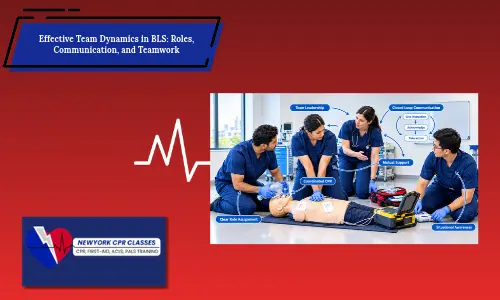
Each rescuer should understand their assigned responsibility. Depending on the number of rescuers and the situation, responsibilities may include chest compressions, airway and ventilation support, AED operation, or team leadership.
Clear assignments help the team begin important tasks without unnecessary confusion. The team can also adjust responsibilities as the response develops.
Effective Team Leadership
A team leader helps organize the response, communicate priorities, and coordinate team members. Leadership does not mean performing every task. The leader needs to maintain awareness of the overall response while allowing other rescuers to perform their assigned responsibilities.
Good leadership also includes listening to information from other team members and responding when a team member identifies a concern.
Closed Loop Communication
Closed-loop communication helps confirm that an instruction has been heard and understood.
For example:
Team leader: “Alex, start chest compressions.”
Alex: “Starting chest compressions.”
Team leader: “Continue compressions.”
The person receiving the instruction acknowledges it and communicates the action. This creates a clear communication loop and helps the team know that the task has been recognized.
Situational Awareness
Team members should remain aware of the patient, their own responsibilities, and what other rescuers are doing.
A responder focused only on an individual task may miss an important change in the situation. Situational awareness helps team members recognize when a role change is needed, confirm that the AED is ready, and identify problems affecting CPR.
Mutual Support
Team members should support one another throughout the resuscitation. Support can include offering assistance, pointing out a potential problem, helping with a task, or sharing information another team member needs.
Mutual support should remain focused on patient care and team performance.
Constructive Intervention
Team members should be willing to speak up when they notice a problem that could affect the response.
For example, if a responder notices that the AED is not ready or that a role has not been assigned, they can communicate the issue clearly rather than assuming someone else will address it.
Constructive intervention helps the team identify problems early and maintain coordination.
Coordinated CPR Performance
High-quality CPR depends on more than the technique of the person performing compressions. The rest of the team can support CPR quality by coordinating ventilations, preparing the AED, assisting with role changes, and handling other necessary tasks.
The team should work to avoid unnecessary interruptions in CPR while following the appropriate BLS sequence. The 2025 AHA Adult BLS Guidelines continue to identify high-quality CPR and AED use as core elements of adult BLS.
Debriefing and Feedback
After a training scenario or resuscitation event, reviewing team performance can help identify communication problems, role confusion, and other opportunities for improvement.
The 2025 AHA resuscitation education guidance includes teamwork and leadership training, rapid cycle deliberate practice, and scripted debriefing as important components of resuscitation education.
What Are the Roles in a BLS Resuscitation Team?
A high-performance team uses three critical BLS roles that work together during resuscitation:
Role of Compressor
Performs chest compressions at the correct rate and depth, allows full chest recoil, and minimizes interruptions.
Role of Airway
Manages the airway and provides ventilations as appropriate. This rescuer coordinates ventilation with the compressor and communicates any concerns to the team.
Role of Monitor/Defibrillator/CPR Coach
Operates the AED, monitors the resuscitation, and provides feedback to help maintain CPR quality. This role also helps coordinate rhythm checks and role changes.
How Do BLS Teams Coordinate During CPR?
A coordinated BLS response may require team members to handle different responsibilities during the resuscitation.
The team first recognizes the emergency and activates the emergency response system. Rescuers then begin CPR and other necessary BLS interventions, while other team members retrieve the AED and other needed equipment or take on specific team responsibilities.
One responder may perform chest compressions while another manages the airway and ventilations. Another rescuer can prepare the AED when one is available. A team leader or another designated responder can coordinate these activities and communicate important instructions.
As the response continues, team members maintain awareness of CPR quality, AED readiness, role assignments, and changes in the patient’s condition. Clear communication helps the team coordinate these responsibilities without unnecessary confusion.
The 2025 AHA Adult BLS Guidelines provide separate algorithms for healthcare professionals and lay rescuers and emphasize the core BLS response for cardiac arrest.
How Can a BLS Team Maintain High-Quality CPR?
A BLS team can maintain high-quality CPR by monitoring performance throughout resuscitation and making timely adjustments when CPR quality begins to decline. Team members should work together to maintain consistent performance from the start of resuscitation through ongoing care.
Core CPR Performance Metrics:
- Compression Rate: Perform chest compressions 100 to 120 times per minute.
- Compression Depth: For an adult, push the chest down at least 2 inches (5 cm) with each compression. Do not compress the chest deeper than 2.4 inches (6 cm).
- Chest Recoil: Allow the chest to return fully to its normal position after each compression.
- Minimal Pauses: Keep interruptions in chest compressions under 10 seconds and aim for a Chest Compression Fraction (CCF) above 80%.
- Avoid Overventilation: Provide rescue breaths smoothly without delivering excessive air or ventilating too quickly.
- Compressor Switch: Change the person performing chest compressions about every 2 minutes. Change sooner if the compressor becomes tired and can no longer maintain the required compression quality.
What Can Disrupt BLS Team Dynamics?
Several factors can interfere with effective teamwork during a resuscitation. These problems can affect how quickly tasks are completed, how information is shared, and how well team members coordinate their actions.
Unclear Responsibilities
When team members are unsure about their responsibilities, an important task may be delayed, overlooked, or performed by more than one person. Assigning responsibilities early helps each responder understand what they are expected to do during the resuscitation.
Poor Communication
Unclear instructions or several people speaking at once can make it difficult for team members to understand what needs to be done. Failing to confirm an assignment can also lead to missed or misunderstood instructions during the resuscitation.
Lack of Situational Awareness
A responder who focuses only on an individual task may miss changes affecting the overall resuscitation. Team members should remain aware of what is happening around them and share relevant observations with the rest of the team.
Compressor Fatigue
Chest compressions require physical effort, and fatigue can affect compression quality. The team should recognize when the compressor is becoming tired and coordinate a change in responsibility to help maintain effective compressions.
Hesitation to Speak Up
A team member may notice an error or developing problem but hesitate to mention it. This can allow the problem to continue and affect the response. Team members should be able to raise relevant concerns clearly and respectfully when they identify an issue.
Limited Team Practice
Strong individual BLS skills do not automatically result in effective team performance. Teams also need opportunities to practice working together, including role assignment, communication, coordination, and decision-making. Regular practice can help identify
How Can Teams Improve BLS Team Dynamics?
Teams can strengthen their performance by focusing on the following practical strategies:
- Conduct a debriefing: After a training scenario, discuss what happened, where the response could improve, and which team behaviors should be practiced again.
- Practice realistic scenarios: Use simulated resuscitation situations that require team members to respond to changing conditions and perform their responsibilities under realistic circumstances.
- Assign roles at the start: Identify the compressor, airway provider, and monitor/defibrillator/CPR coach early so each person knows their responsibility before the response progresses.
- Use closed-loop communication: Give the instruction to a specific team member, have them acknowledge it, and confirm when the task is complete.
- Rotate responsibilities during practice: Allow team members to practice different positions so they can become familiar with the demands of each role and transition smoothly when a change is needed.
- Encourage team members to speak up: Rescuers should communicate concerns, request assistance when needed, and respectfully identify problems that may affect patient care.
Taking an AHA BLS course can help you understand how to apply these teamwork principles during a resuscitation. Through BLS training, you can practice CPR, AED use, role coordination, and communication while developing the skills needed to work effectively with other rescuers.
BLS Training for Effective Teamwork During CPR
Effective BLS training goes beyond individual CPR skills. Team-based practice allows participants to apply communication, role assignment, AED coordination, and other BLS responsibilities while responding to realistic resuscitation scenarios. For healthcare professionals and other trained responders, practicing team communication and coordination during resuscitation can strengthen their BLS knowledge and technical skills.
New York CPR Classes offers AHA BLS, ACLS, PALS, Heartsaver CPR/AED, and Heartsaver First Aid CPR/AED courses in New York. We have multiple skill verification stations throughout the United States, so you do not have to travel far to complete your required skills verification. After completing all required course components, you can receive your AHA eCard on the same day.
Frequently Asked Questions About Effective Team Dynamics in BLS
What Are Examples of Effective Team Dynamics in BLS?
For example, during a resuscitation, one rescuer performs chest compressions while another manages the airway, and a third prepares the AED and communicates when it is ready. This clear division of responsibilities allows the team to coordinate their actions without interrupting essential CPR.
What Is Important for a BLS Team to Do After a Resuscitation Event?
The team should review the resuscitation afterward to discuss what went well, identify any problems, and determine what could be improved. A structured debriefing helps the team review how the resuscitation was handled, identify communication or role problems, and determine what should be improved in future responses.
What Is Summarizing and Reevaluating in BLS Team Dynamics?
Summarizing and reevaluating involves reviewing the current situation, confirming what has been done, and determining what needs to happen next. This helps the team stay aware of the patient’s condition, each member’s responsibilities, and any changes that may require adjustments to the response.
Which Team Role Provides Feedback on Compressions and Breaths?
The monitor/defibrillator/CPR coach role provides feedback on CPR performance, including the quality of compressions and ventilations. This role can help the team recognize when CPR performance needs adjustment while other rescuers continue their assigned tasks.
How Should a BLS Team Respond When a Problem Is Identified?
The team member who notices the problem should communicate the concern clearly to the appropriate responder or team leader. The team should then address the problem while maintaining essential BLS actions and reassessing responsibilities if needed.
Can BLS Team Dynamics Be Effective With Only Two Rescuers?
Yes. Two rescuers can divide the essential BLS responsibilities between them and adjust their tasks as needed. One rescuer can perform chest compressions while the other manages the airway, provides ventilations, and operates the AED when available.
What Should a BLS Team Do When a New Rescuer Arrives?
The team should quickly identify which responsibilities are already covered and assign the new rescuer a specific task. A clear assignment allows the new responder to join the resuscitation without creating confusion or interrupting ongoing CPR.
How Should a BLS Team Handle an Unexpected Change During Resuscitation?
The team should communicate the change clearly, reassess current responsibilities, and adjust tasks as needed. Essential BLS actions should continue while another team member addresses the new problem whenever possible.
Why Is Role Clarity Important When Team Members Switch Positions?
Role clarity helps the incoming rescuer understand which responsibilities they are taking over and reduces the chance of a task being missed during the transition. Team members should clearly communicate the role change before the new rescuer takes over.
What Is the Difference Between BLS Team Dynamics and Individual BLS Skills?
Individual BLS skills focus on performing tasks such as chest compressions, ventilations, and AED use correctly. Team dynamics focus on how rescuers coordinate these skills, communicate with one another, and manage their responsibilities during the resuscitation.