
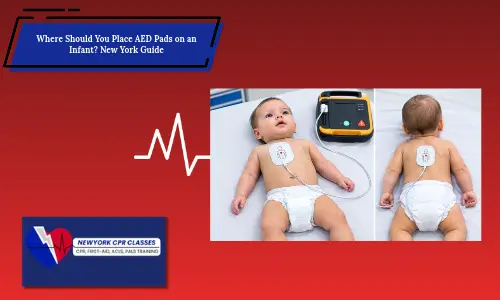
When an infant experiences cardiac arrest, an AED may be needed to help restore a normal heart rhythm. For an infant, place one AED pad on the chest and the other on the back, or place one pad on the right side of the chest and the other on the left side. Choose the position that keeps the pads separated without touching or overlapping.
This guide explains when an infant may need an AED, where to place the pads, how to choose the best pad position, and what to do if pediatric pads are unavailable.
Can an AED Be Used on an Infant?
Yes. An AED can be used on an infant during cardiac arrest to analyze the heart rhythm and deliver a shock when appropriate. If pediatric pads or a pediatric attenuator are available, use them when treating an infant with an AED.
Furthermore, an AED may be needed after:
- Drowning or submersion: Severe oxygen deprivation can cause the heart to stop.
- Choking: A complete airway blockage can prevent adequate oxygen from reaching the body and may lead to loss of circulation.
- Severe trauma: A serious injury can cause the heart to stop and require immediate resuscitation.
- Sudden collapse from an unknown cause: The reason for the infant’s collapse may not be known, so an AED can assess the heart rhythm and determine whether a shock is advised.
How to Place AED Pads on an Infant?
The 2025 American Heart Association and American Academy of Pediatrics guidelines recognize two options for AED pad placement on an infant: anterior-posterior and anterior-lateral. Either position works as long as the pads fit securely and do not touch or overlap.
1. Anterior Posterior Placement
- Place one pad on the center of the infant’s bare chest.
- Place the other pad on the center of the infant’s back.
- Keep enough space between the pads to prevent them from touching or overlapping.
2. Anterior Lateral Placement
- Place one pad vertically on the right side of the chest, with its top edge just below the collarbone.
- Place the other pad horizontally on the left side of the chest near the midaxillary line.
- Keep the pads away from breast tissue and the abdomen.
- Make sure the pads do not touch or overlap.
How Do You Choose the Right AED Pad Position?
Choose the pad position based on the infant’s size and the amount of space available on the chest. Both pads must fit securely on the skin without touching or overlapping.
If there is enough space to keep the pads separated, anterior lateral placement may be appropriate. If the chest is too small for this position, anterior-posterior placement can provide greater separation by placing one pad on the chest and the other on the back.
Note: Use the largest pads that fit the infant while maintaining adequate separation. Follow the pad placement instructions provided with the specific AED.
Can Adult AED Pads Be Used on an Infant?
Yes. For an infant, use pediatric AED pads when they are available. If pediatric pads are not available, use adult AED pads instead. Check the AED manufacturer’s instructions for the correct pad type and placement.
Pediatric pads are preferred when available. Some AEDs use a pediatric attenuator to adjust the energy delivered during defibrillation. When pediatric AED pads are not available, use adult pads on the infant or child rather than delaying defibrillation.
When placing pediatric AED pads on an infant, make sure each pad sticks firmly to the skin and that the pads do not touch or overlap. Follow the AED manufacturer’s instructions for pad placement. When using adult pads, leave enough space between the pads so they do not touch or overlap. If they are too large to fit safely on the chest, an anterior-posterior position can provide greater separation when supported by the AED instructions.
How Should You Prepare the Infant Before Using the AED?
Before applying the AED pads, make sure the infant’s chest is ready for proper pad placement and skin contact.
- Remove clothing from the infant’s chest to expose the skin where the pads will be placed.
- Dry the chest if it is wet.
- Remove anything that may prevent the pads from sticking securely to the skin.
- Check for medication patches or implanted medical devices near the intended pad locations.
- Follow the AED manufacturer’s instructions when medication patches or implanted devices are present.
Follow the proper steps for operating an AED and use its voice prompts for pad placement and defibrillation.
What Should You Do After Applying the AED Pads?
Once the AED pads are securely attached, turn on the device and follow its voice or visual instructions. The AED will analyze the infant’s heart rhythm and determine whether a shock is advised.
Continue following the AED prompts throughout the analysis and treatment. These steps help ensure the device can assess the rhythm and deliver a shock safely when indicated.
- Keep everyone away from the infant while the AED analyzes the heart rhythm.
- Keep everyone clear if the AED announces that a shock is advised.
- Deliver the shock only when instructed by the AED.
- Resume CPR as directed by the AED after the analysis or shock.
Heartsaver CPR and AED training can help you learn how to perform CPR and use an AED correctly for infants during a cardiac emergency.
Using an AED With One or Two Rescuers
When two rescuers are present, one person can continue CPR while the other gets the AED, turns it on, and prepares it for use. This allows CPR to continue while the AED is brought to the infant.
When only one rescuer is present, the response depends on how the collapse occurred. The rescuer should activate the emergency response system, begin CPR, and use the AED as soon as it is available.
For a sudden witnessed collapse, the rescuer can retrieve the AED immediately before starting CPR. For an unwitnessed collapse, the rescuer should begin CPR first and use the AED as soon as it becomes available.
Does AED Use Differ for a Newborn?
Yes. A newborn who needs resuscitation immediately after birth is managed under neonatal resuscitation guidance rather than the pediatric BLS approach used for an infant who experiences cardiac arrest later.
The circumstances of the emergency determine which resuscitation guidance applies. A newborn in the immediate period after birth requires neonatal resuscitation, while an infant who experiences cardiac arrest after this period is managed according to pediatric resuscitation guidance.
Infant CPR and AED Training in New York
Quick action during an infant cardiac emergency can help maintain circulation and improve the chances of survival. CPR and AED training helps parents, caregivers, childcare providers, and other responders develop the skills needed to perform infant CPR and use an AED correctly.
New York CPR Classes offers Heartsaver CPR AED and Heartsaver First Aid CPR AED courses for parents, caregivers, and childcare providers. Healthcare professionals can choose courses such as BLS, ACLS, and PALS based on their professional needs. Our blended learning format combines online coursework with a hands-on skills session, allowing participants to practice CPR and AED skills. After completing the course, you will receive your official AHA eCard the same day. Your AHA credential is recognized throughout the United States.
Frequently Asked Questions
How Old Is Considered an Infant for AED Use?
For CPR and AED guidance, an infant is generally a child younger than 1 year.
What Happens If the AED Says No Shock Is Advised?
A “No Shock Advised” message means the AED has detected a heart rhythm that does not require a shock. Continue CPR and follow the AED’s instructions.
Can an AED Be Used on an Infant With a Medication Patch?
Yes. Check the intended pad locations for medication patches before applying the pads. Follow the AED manufacturer’s instructions for handling a patch near the pad location.
Do Infant AED Pads Deliver Less Energy Than Adult Pads?
Yes. Pediatric AED pads deliver less energy than standard adult pads to provide an appropriate shock for an infant or child.
Should You Continue CPR While the AED Is Analyzing the Infant’s Heart Rhythm?
No. Stop CPR and keep everyone clear while the AED analyzes the infant’s heart rhythm.