
When a child experiences sudden cardiac arrest, an automated external defibrillator (AED) can help restore the heart’s normal rhythm by delivering an electrical shock. However, placing the AED pads correctly is essential for the device to work effectively. Since children have smaller chests than adults, rescuers may need to use a different pad position to ensure both pads fit properly.
On children, AED pads can be placed on the front and back or the front and side of the chest. The correct position depends on the child’s size and the type of AED pads available.
This guide explains where to place AED pads on children, how to apply them step by step, which pads to use, and common placement mistakes to avoid during a pediatric cardiac emergency.
Where to Place AED Pads on a Child Under 8 Years?
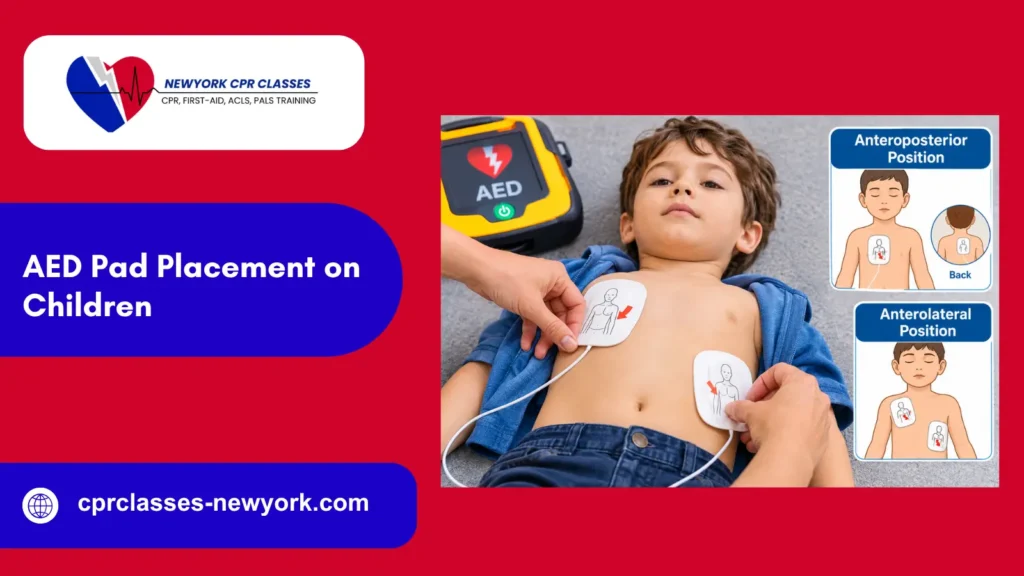
For children under 8 years old, AED pads can be placed in either the anteroposterior or anterolateral position. The appropriate position depends on the child’s size and the space available for pad placement.
The correct position depends on the child’s chest size and the type of AED pads available.
- Front and back (anteroposterior): Place one pad in the center of the child’s chest and the other in the center of the upper back. This position is a good option for smaller children when there is not enough room to place both pads on the chest without them touching.
- Front and side (anterolateral): Place one pad on the upper right side of the chest and the other on the lower left side, below the armpit. Use this position when the child’s chest is large enough to keep the pads from touching.
The 2025 American Heart Association (AHA) guidelines consider either position reasonable for children when using self-adhering defibrillator pads. Always use the largest pads that fit properly without overlapping or touching.
How to Apply AED Pads on a Child Step by Step
Correct pad placement is only one part of using an AED. Follow these steps when responding to a child experiencing suspected cardiac arrest.
Step 1: Check the child and call for emergency help
Check whether the child responds and is breathing normally. If the child is unresponsive and not breathing normally or is only gasping, activate emergency medical services and begin CPR.
Step 2: Turn on the AED
Turn on the AED as soon as it becomes available. Follow its voice instructions and prepare the child’s chest for pad placement.
Step 3: Select the appropriate pads
Use pediatric AED pads and a pediatric attenuator if available for a child younger than 8 years. Follow the manufacturer’s instructions for selecting the correct equipment.
Step 4: Expose the child’s chest
Remove clothing covering the chest. Dry the chest if wet and remove any medication patches before applying the AED pads.
Step 5: Apply the AED pads
Place the pads in the anteroposterior or anterolateral position, depending on the child’s size and the device instructions. Make sure the pads have good contact with the skin.
Step 6: Allow the AED to analyze the heart rhythm
Tell everyone to stand clear while the AED analyzes the heart rhythm. Nobody should touch the child during analysis.
Step 7: Deliver a shock if advised
If the AED recommends a shock, make sure everyone is clear of the child before pressing the shock button or allowing the device to deliver it automatically.
Step 8: Resume CPR
Immediately resume CPR after the shock or if the AED announces that no shock is advised. Continue following the AED’s instructions until emergency medical professionals take over.
Can You Use Adult AED Pads on a Child?
Yes. You can use adult AED pads on a child when pediatric pads are not available. Make sure the pads do not touch or overlap when placed on the child’s chest.
For children younger than 8 years, use pediatric pads with an AED pediatric attenuator whenever available. The attenuator reduces the shock energy to a level appropriate for children.
If pediatric pads or an attenuator are unavailable, use the AED with adult pads rather than delaying defibrillation. Follow the device’s voice prompts and pad placement instructions.
Common AED Pad Placement Mistakes to Avoid
Incorrect AED pad placement can interfere with the electrical current traveling through the heart. Avoid these common mistakes when using an AED on a child.
1. Allowing the pads to touch
Pads that touch or overlap can interfere with proper shock delivery. Maintain adequate space between them.
2. Placing pads over clothing
AED pads must make direct contact with the child’s bare skin. Remove clothing covering the chest before applying them.
3. Using the wrong pad position
Choose an anteroposterior or anterolateral position based on the child’s chest size and the AED instructions.
4. Placing pads over breast tissue
Avoid placing AED pads directly over breast tissue. Position them slightly to the side while maintaining the recommended pad placement.
5. Delaying AED use
Do not waste time searching for pediatric pads when adult pads are available. Apply the available AED and follow its instructions.
6. Touching the child during rhythm analysis
Everyone must stay clear while the AED analyzes the heart rhythm or delivers a shock.
Get CPR and AED Training in New York
Correct AED pad placement on children helps ensure that the electrical current travels through the heart during defibrillation. Proper CPR and AED training teaches you how to recognize an emergency, perform CPR, and use an AED safely.
At New York CPR Classes, you can enroll in American Heart Association (AHA) BLS, ACLS, or PALS courses. Complete your online coursework and in-person skills assessment to receive your nationally recognized AHA eCard. You can receive your AHA eCard the same day after completing the course and skills assessment.
Frequently Asked Questions
Can you use an AED on a child who has been rescued from water?
Yes. Remove the child from the water and move them to a dry area. Dry the child’s chest before applying AED pads and make sure there is no standing water around them.
What should you do if AED pads do not stick to a child’s chest?
Make sure the child’s chest is clean and dry before applying the pads. Press each pad firmly against the skin to ensure proper contact. If a pad will not stick, follow the AED manufacturer’s instructions.
What is the difference between pediatric and adult AED pads?
Pediatric AED pads are used with a pediatric attenuator to reduce the shock energy delivered to a child’s heart. Adult AED pads deliver the standard energy level used for adults.
Can you use an AED on a child who is having a seizure?
Yes. If a child experiences sudden cardiac arrest during or after a seizure, an AED can be used. Make sure the child is no longer moving before applying the pads and follow the AED instructions.
Can you use an AED on a child with a chest injury?
Yes. A chest injury does not automatically prevent AED use. Avoid placing pads directly over an open wound or injury, and follow the manufacturer’s placement instructions.
Can you use an AED on a child with wet clothing?
Remove wet clothing and dry the child’s chest before applying AED pads. The pads must make direct contact with dry skin to work properly.